Beasts of Legend: Animals in East Asian Art (on view November 21, 2026–February 21, 2027) explores the enduring lives of three of East Asia’s most recognizable creatures—the dragon, tiger, and monkey—and the ways their meanings have shifted across time, place, and artistic traditions. Among them, few characters have enjoyed an afterlife as lively as the Monkey King. Rebellious, arrogant, ingenious, and capable of transformation, he has moved between religion, literature, theater, and art for centuries, continually reinvented for new audiences.
The Monkey King is best known today as Sun Wukong, the irrepressible hero of the 16th-century Chinese novel Journey to the West, but his history dates back much further. Monkey figures associated with Buddhist pilgrimage circulated in China centuries earlier, suggesting that Sun Wukong emerged from an older mixture of Buddhist traditions and local folklore.
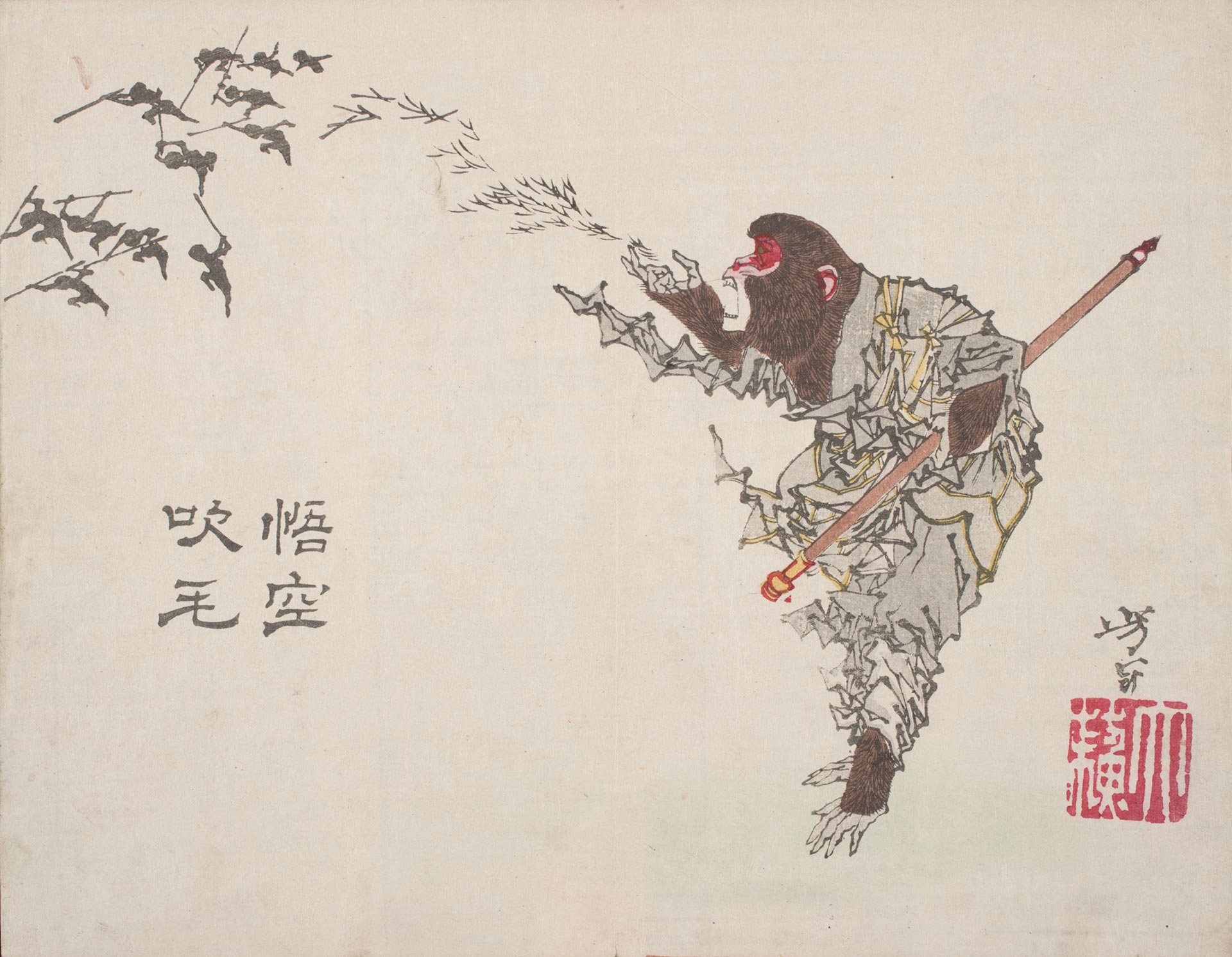
In Journey to the West, Sun Wukong is born from a magical stone and becomes king of the monkeys. Seeking immortality, he studies with a Daoist master and acquires supernatural abilities, including 72 transformations and cloud-somersaulting (fig. 1). His extraordinary powers are matched by an equally formidable ego. After challenging heaven’s authority, he proclaims himself the “Great Sage Equal to Heaven.” The Buddha eventually subdues him, imprisoning him beneath a mountain for 500 years.
Sun Wukong’s opportunity for redemption comes through the bodhisattva Guanyin, who arranges his release on the condition that he protect the Buddhist monk Xuanzang on a journey to India to retrieve sacred scriptures. Joined by Zhu Bajie, or Pigsy, and the river ogre Sha Wujing, or Sandy, the pilgrims encounter monsters, temptations, and 81 trials. Through these adventures, the unruly Monkey King gradually learns discipline and ultimately attains enlightenment.
Be the first the hear about new articles and videos in the Member Monthly email newsletter. Members receive year-round free admission, tickets to events, and more.
The story traveled widely across East Asia, where Sun Wukong became known as Son Goku in Japan and Son Ogong in Korea. Scholars have also noted intriguing parallels with Hanuman, the monkey deity of South Asian Hindu tradition. Although their precise relationship remains debated, these similarities raise fascinating questions about how stories and supernatural beings transformed as Buddhism traveled from India through China and farther east.
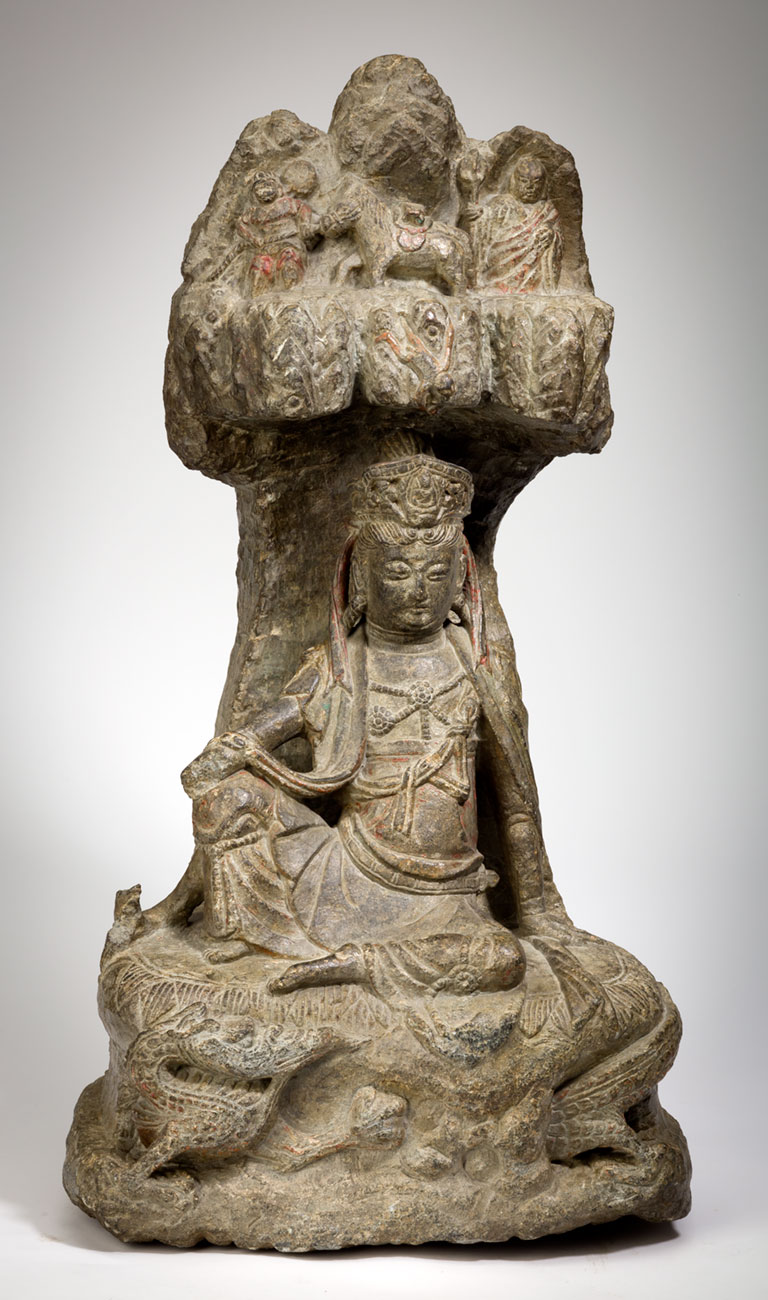
Beasts of Legend—on view this fall—traces this long history through works spanning centuries. The exhibition’s earliest representation associated with Sun Wukong predates the famous novel. In a Song-dynasty Buddhist sculpture, Guanyin sits within a grotto, while above her a monk and horse appear beside a simian figure identified as Sun Wukong (fig. 2). Another monkey reaches toward the bodhisattva below, emphasizing Guanyin’s role in guiding the monkey toward spiritual reform.
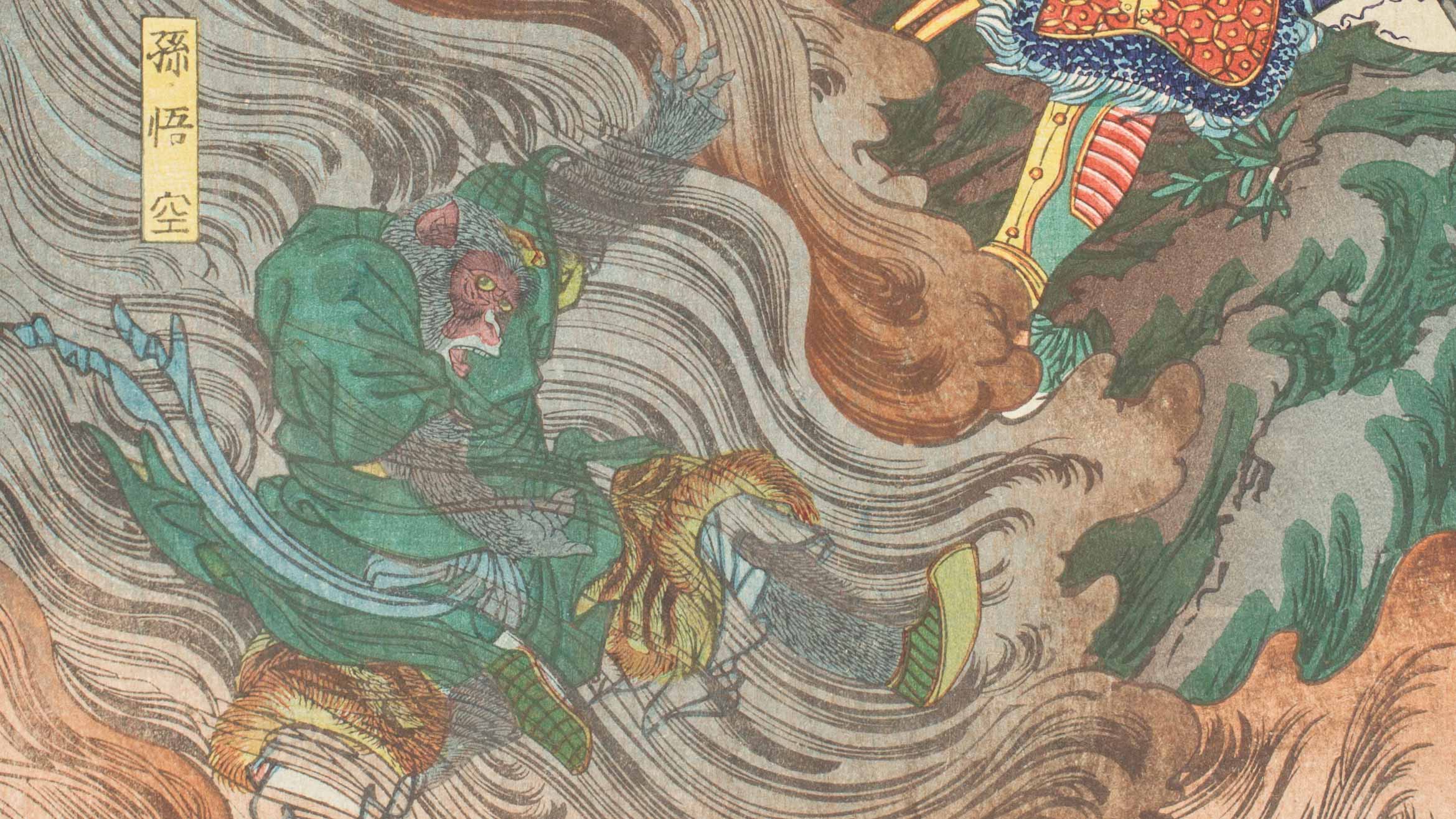
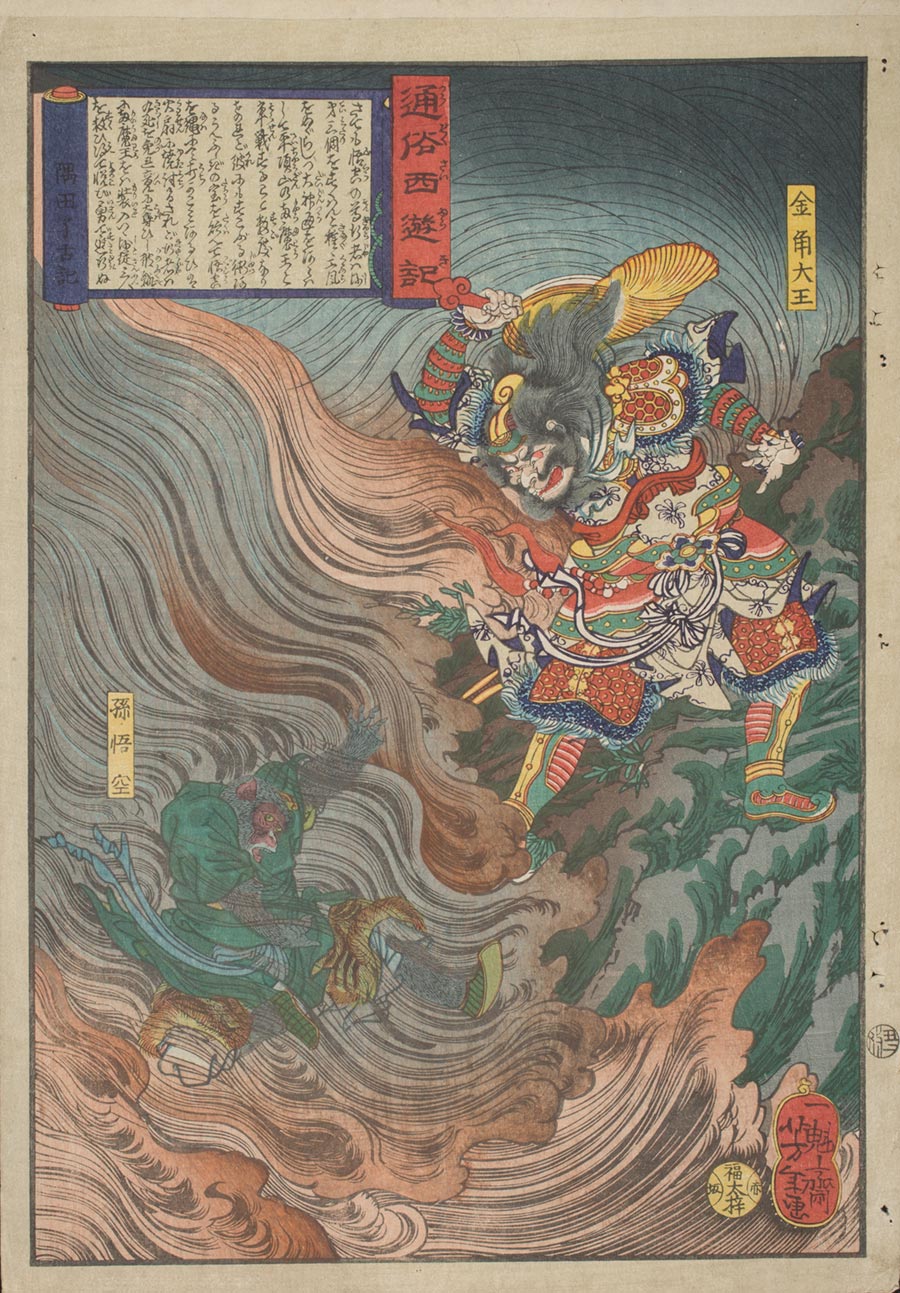
Centuries later, Journey to the West found enthusiastic audiences in Japan. Woodblock prints by ukiyo-e artist Tsukioka Yoshitoshi (1839–1892) transform its adventures into spectacular scenes of supernatural combat, including Sun Wukong’s confrontation with the Golden-Horned Demon King (fig. 3). Korean masked performance traditions offer another perspective. Although their mischievous monkey characters are not directly connected to Sun Wukong, they similarly use the unruly animal to parody human behavior.
The exhibition also brings this history into the present. Xu Bing’s (Chinese, b. 1955) Monkeys Grasp for the Moon (2001, 2008) transforms a Buddhist parable about a group of monkeys into a meditation on cooperation, illusion, and futile pursuits. A newly commissioned painting by Mu Pan (Chinese American, b. 1976) expands the theme to encompass monkeys and other animals in a shared struggle for liberation, with Guanyin at its center. (Learn more on page 18.) Across centuries and cultures, the monkey remains disruptive and comic, but also profoundly human—a figure whose struggle between impulse and enlightenment mirrors our own.