
Exhibition Explores the 19th-Century Frenzy for Ancient Tanagra Figurines, Uncovering Complex Histories of Discovery, Forgery, and Collecting
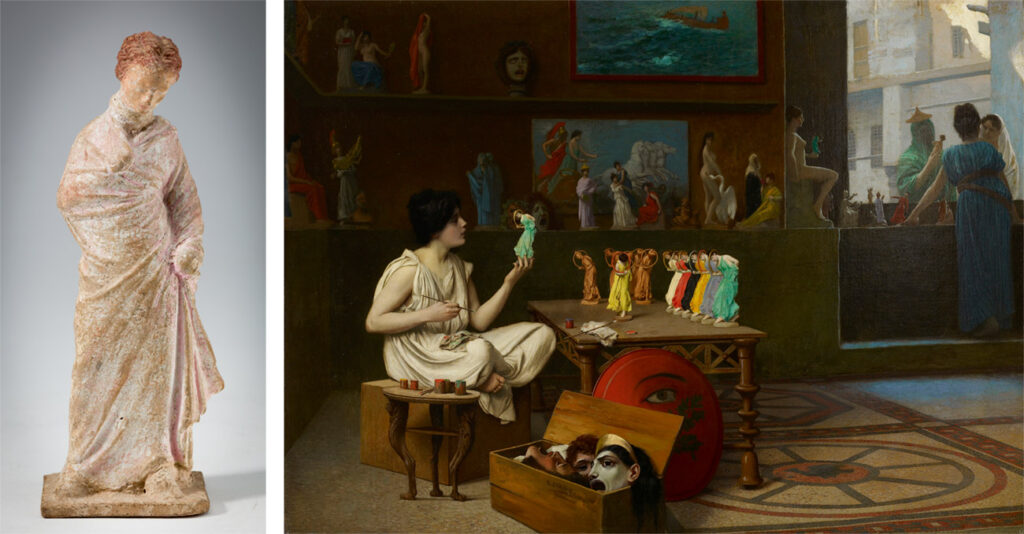
WORCESTER, MA—October 22, 2026—Next May, the Worcester Art Museum will present Tanagramania: The Modern Craze for Greek Antiquities, the first major American exhibition to examine the discovery and broad cultural impact of these small terracotta statuettes, from the 1870s through the 1920s. The exhibition will also directly address the entangled questions of provenance and forgery that surround these objects, which were prized for their small size, colorfully painted surfaces, and depictions of everyday people from ancient Greece. The exhibition, which will be on view May 15 through August 15, 2027, brings together over 70 objects including sculptures, paintings, and works on paper drawn from leading institutions and WAM’s own significant collection of Tanagra figurines, replicas, and forgeries.
“Tanagras represent a fascinating chapter in the history of collecting,” said Daniel Healey, WAM’s Provenance Research Specialist and the curator of Tanagramania. “They swept through culture—art, fashion, dance, literature—with a speed and thoroughness that feels completely contemporary. The story of the Tanagras’ discovery and reception, which involves looting, forgery, and the birth of American museums, is also relevant at a time when such histories are under scrutiny by museums and their audiences.”
Tanagra sculptures are named for the ancient Greek site where they were found in the thousands in the early 1870s, first by local farmers working the soil and later by widespread, unregulated digging. The Tanagras represent a style of figurine that was pioneered in Athenian workshops around 340–330 BCE but that spread throughout the Mediterranean. Made with molds but often finished by hand and exquisitely painted, the Tanagras captivated 19th-century audiences with their fashionable dress and relaxed poses.
The discovery of the Tanagras sparked a full-blown collecting frenzy on both sides of the Atlantic. Artists, writers, and collectors could not get enough of them; even Oscar Wilde had his character Dorian Gray compare his lover to a Tanagra figurine. But the craze also inspired looting and widespread forgery as the demand for the figurines rapidly outpaced supply. At the same time, commercial manufacturers created replicas for those who could not afford, or could not obtain, the real thing. The exhibition explores these varied manifestations of “Tanagramania,” including excavated figurines, clever forgeries, reproductions, and modern recreations.
Tanagramania addresses this history through four sections. Section 1, Discovery and the Collecting Craze, opens with the moment Tanagras entered the Western imagination following their discovery in the 1870s, setting off a collecting frenzy among the wealthy and the culturally ambitious. This section traces how dealers like Gaston L. Feuardent brought Tanagras to America. In the second and third sections, Forgeries and Replicas, the exhibition explores questions of authenticity and emulation. These sections highlight WAM’s own collection of figurines, which includes authentic Tanagras, replicas, and a few fascinating forgeries, recently exposed through scientific testing.
The final section, Artists and Tanagras, explores how painters, printmakers, sculptors, and writers absorbed and transformed the Tanagra aesthetic, exemplified in Thomas Pollock Anshutz’s celebrated canvas The Tanagra. The painting depicts a replica of the widely produced Titeux Dancer Tanagra, and will be shown alongside an identical replica. At its height, the Tanagra craze had a wide influence on fashion, performance, and popular culture, from the draping silhouettes that entered haute couture in the early 20th century from designers such as Rosa Genoni, to the influence the figurines exerted on dancers and performers such as Loïe Fuller.
“Tanagramania reflects the creative ways in which museum scholarship informs what goes in our galleries,” said Claire Whitner, the Museum’s Director of Curatorial Affairs and the James A. Welu Curator of European Art. “This exhibition demonstrates how objects from ancient Greece shaped modern American culture in extraordinary ways that are largely unknown to the public. At the same time, in its curatorial honesty about complex questions of provenance and authenticity, it reveals the behind-the-scenes debates of museum curators and researchers and brings this information to the galleries for the consideration and scrutiny of our visitors.”
Accompanying the exhibition, the Museum will publish a catalog titled Tanagramania: The Modern Craze for Greek Antiquities and host a variety of public programs and events, with more information to be announced soon.
About the Worcester Art Museum
The Worcester Art Museum creates transformative programs and exhibitions, drawing on its exceptional collection of art. Dating from 3000 BCE to the present, these works provide the foundation for a focus on audience engagement, connecting visitors of all ages and abilities with inspiring art and demonstrating its enduring relevance to daily life. Creative initiatives—including pioneering collaborative programs with local schools, fresh approaches to exhibition design and in-gallery teaching, and a long history of studio class instruction—offer opportunities for diverse audiences to experience art and learn both from and with artists.
The Worcester Art Museum, located at 55 Salisbury Street in Worcester, MA, is open Wednesday through Sunday from 10 am to 4 pm. For information on admission and discounts, visit https://www.worcesterart.org/visit. Museum parking is free.
For more information, please contact:
Madeline Feller
Worcester Art Museum
MadelineFeller@worcesterart.org
508-793-4373
Sascha Freudenheim
PAVE Communications & Consulting
sascha@paveconsult.com
917-544-6057
Above:
Greek style, Tanagra Maiden, 450-200 BCE, painted or glazed terracotta, deposited by Philip J. Gentner before 1924, acquired in accordance with Massachusetts General Laws, Chapter 200B: Disposition of Museum Property, 2017.10
Jean-Léon Gérôme, The Antique Pottery Painter: Sculpturae vitam insufflat pictura, 1893. Oil on canvas, Overall: 50.1 x 68.8 cm. Art Gallery of Ontario. Gift from the Junior Women’s Committee Fund, 1969. Photo © AGO. 69/31