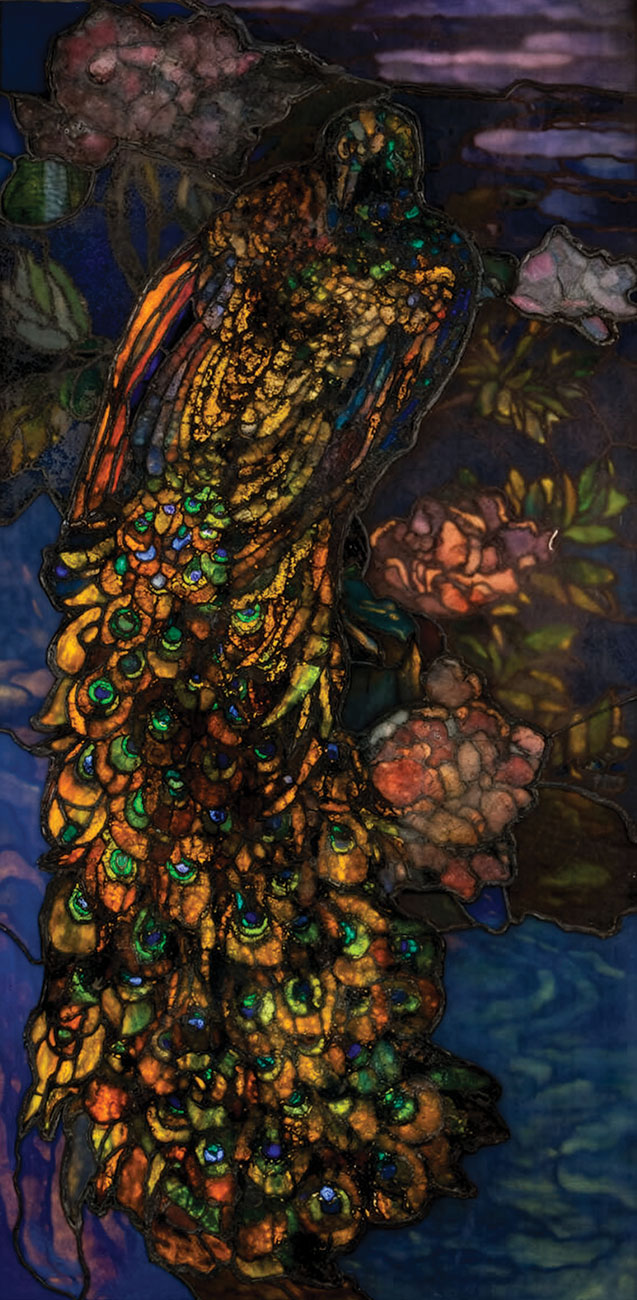
Behind the scenes in the Conservation Lab, Amanda Chau was embroiled in a mystery. The Andrew W. Mellon Fellow in Objects Conservation at WAM was tasked with caring for pieces of glass in John La Farge’s prized Peacock Window. The most experimental of his stained-glass windows, in which he abundantly employed fused glass techniques, was also his most curious. It was her job to get to the bottom of many questions surrounding this notable work before she began her assignment: restore and conserve the 110-year-old window.
WAM purchased the 20 x 40-inch window from La Farge himself in 1908, just two years before the artist died, and exhibited it in the American Galleries for decades. Time and ambient conditions took their toll. A century and some years later, the work fell under the scrutiny of our conservation staff, along with scientists from around the country.
Before Chau could begin working on the window, there were many questions to answer. What had the artist intended? What was at first a mistake, but later, acceptable? What was wrong and needed to be restored? And, how much of the dark and dense interior of this multilayered work of exquisite beauty was dirty and how much of it was the piling on of glass that had been cut, fused, shattered, and/or painted with purpose? The assessment process took nine months, followed by a full year of repairs and conservation.
“I love this window. It is a spectacular piece. Completing it so late in life, it was as if La Farge had nothing to lose. I have never seen anything like this before,” said Chau, who specializes in stained glass conservation.
Indeed, La Farge had been inspired when he began the piece. The pattern, the elaborate peacock in all of the different, rich, luxe colors came to La Farge after an Asian/South Seas excursion,” said Amanda Lett, guest curator of our yearlong exhibition, Radiance Rediscovered: Stained Glass by Tiffany and La Farge. “He was among several artists of the time who were boundary pushers. James McNeill Whistler and William Merritt Chase were leaders of the aesthetic movement—art for art’s sake. The work defies genre and can’t be bound and neatly pigeonholed.”
Her own first encounter with the window caught Lett by surprise. “The first thing I noticed was the tail, the blue and teal. It isn’t just a little bit of white, with glints of gold and yellow and a little green. These glints catch your eye. They draw you in.”
Peonies in pinks and purples are set against the dark blue background for a sense of depth. The peacock’s feathers are arranged in a raised, circular pattern. “As you come closer, a variety and texture of the glasses becomes more fascinating,” said Lett. “In the exhibition this piece is positioned next to a Tiffany window, which is flat by comparison. The La Farge has modeling and movement. In fact, this amount of texture in this kind of art is unheard of.”
Chau used various imaging techniques including RTI—Reflective Transformation Imaging. This topographical examination lets the viewer see what can’t be seen in high resolution imagery. Scientists from SUNY Buffalo State College helped identify types of paint. And Chau noted how dust and soot had accumulated on and in the glass over the decades.
As Chau’s investigation continued, she found that the shattered glass along the edges of the frame were unintentional, whereas the small pieces of shattered glass in the window itself were purposely cut and applied to produce a sparkling effect.
Once the assessment had been completed, Chau made a rubbing of the leading network so she would know precisely how the pieces fitted together. The window had been cemented into the frame so she had to remove the cement and the corroded lead borders. Next she repaired the glass and replaced the lead.
A greater clarity, more depth, and a far neater presentation are among the results of the conservation. “There are no longer light leaks and distortions,” said Chau. “Now we are free to pay more attention to La Farge’s experimental techniques, knowing what we see is what he intended.”
Taken and adapted from the 2018 fall/winter edition of the Worcester Art Museum’s access Member magazine.
Radiance Rediscovered: Stained Glass by Tiffany and La Farge, June 30, 2018–December 1, 2019
Stay connected! Sign up for the Worcester Art Museum’s email newsletter.