
The Worcester Art Museum’s collection of American watercolors is among its most treasured, yet we rarely get to appreciate these paintings in person. Due to their fragility and sensitivity to light, works on paper spend most of their lives in climate-controlled storage.
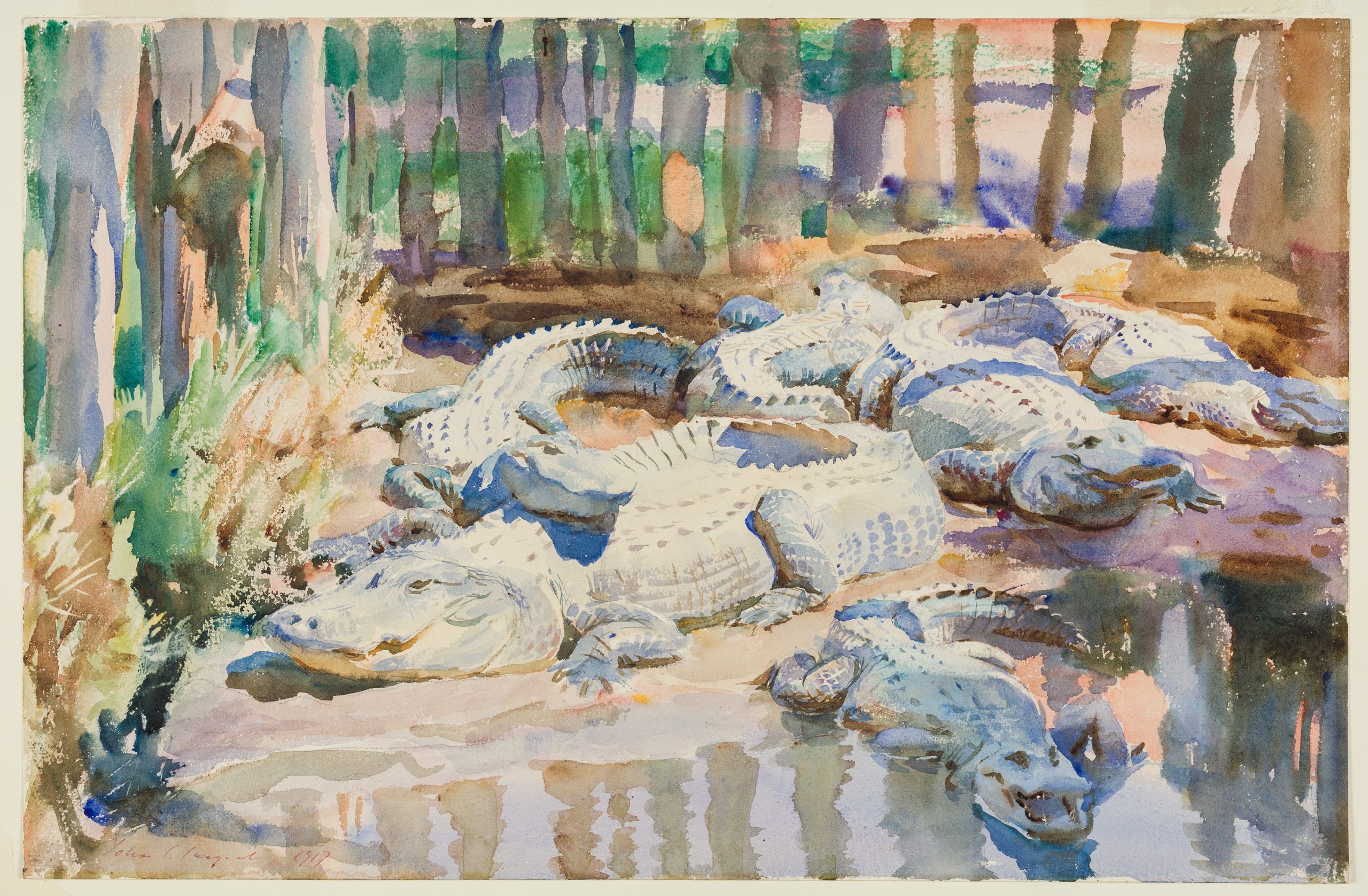
John Singer Sargent and Winslow Homer, whose internationally revered works make up a sizable amount of the Museum’s late 19th- and early 20th-century American watercolor collection. These works exemplify the daunting technical challenges of watercolor as a medium. These include Sargent’s splendid Muddy Alligators (1917)—a masterful depiction of light, shadow, and texture. A seemingly unlikely subject for a renowned portrait painter, the scene of mud-caked alligators sunning themselves at the water’s edge attests to Sargent’s artistic range and virtuosity. The painting reveals a diversity of techniques: scratching into the paper to denote teeth, applying wax resist to suggest rough textures, and laying on broad brushstrokes to delineate tree trunks.
“Sargent’s bravado and understanding of negative space are unrivaled. He appears to paint without hesitation, which is remarkable when working in a medium as unforgiving as watercolor,” says Nancy Kathryn Burns, Stoddard Curator of Prints, Drawings, and Photographs. “It takes an artist with resolve to make bold strokes in watercolor, as it is hard to ‘take back’ a mark once it’s on the paper.”
Be the first the hear about new articles and videos in the Member Monthly email newsletter. Members receive year-round free admission, tickets to events, and more.
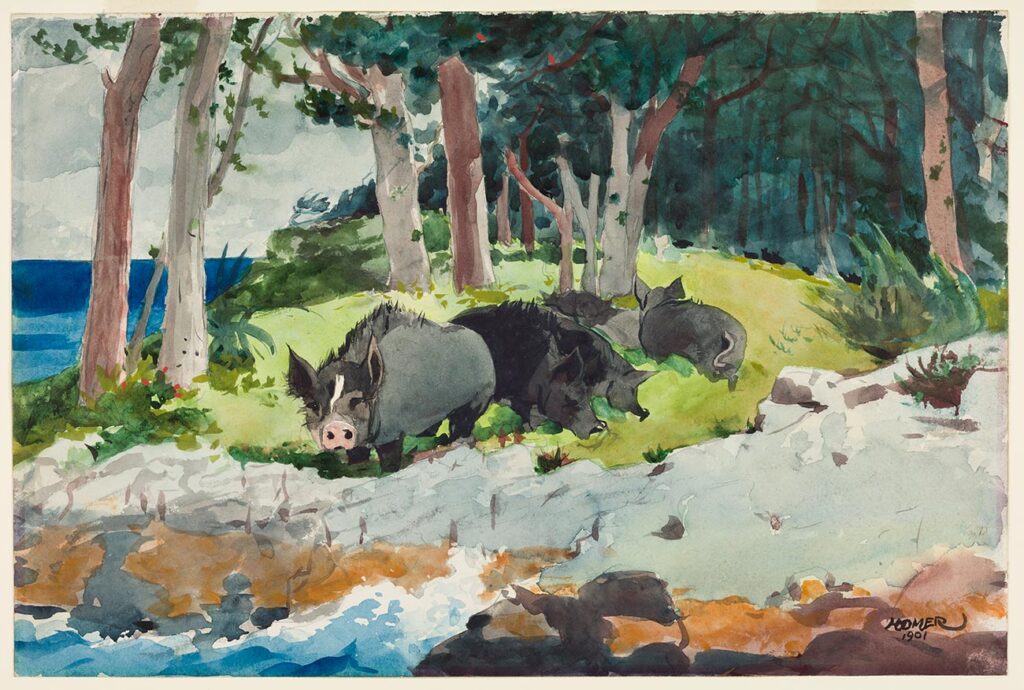
The genius of Winslow Homer is revealed in several works in the Museum’s collection. The subjects of these works span across different locales he visited, including Bermuda, the Bahamas, and New England. Homer’s diverse watercolors mark his many shifts in style, as well as his extraordinary understanding of how to manipulate the medium to create spatial depth. In Bermuda Settlers (1901), the crisp sunlight, deep-blue sea, and green grass all convey a sense of untouched natural beauty. At the center of his composition, Homer depicts five razor-back hogs grazing, one of which pauses and looks directly at the viewer. In contrast with many of Homer’s other works that express competition in nature and impending loss, this watercolor conveys a timeless image of nature’s richness and comfort.
“While Sargent’s work is marked by passion, Homer is admired for his patience working in an impatient medium,” explains Burns. “He was adept at fixing mistakes, scraping paper to remove errors, and using his areas of removal as representative elements in a scene. Visitors to the exhibition will be able to better understand Homer’s clever corrections.”
The Museum also hosts many European watercolors. Mostly portraits, the works reflect the fact that by the early twentieth century American artists had effectively claimed landscape as their signature subject in watercolor. At the same time, avant-garde art movements like Fauvism and Cubism had taken hold in Europe. These movements tended to focus primarily on the figure. The Museum’s European watercolors are no exception, the majority of which reflect the influence of artists like Matisse on German, Russian, and Italian artists who were processing French contemporary art from afar.
Taken and adapted from the 2023 spring/summer edition of the Worcester Art Museum’s access Member magazine.
Watercolors Unboxed, June 10–September 10, 2023
Stay connected! Sign up for the Worcester Art Museum’s email newsletter.