Drawing on the Museum’s Exceptional Collection of American Art Before 1900, the New Installation Brings More Works on View, With More Variety, and a New Interpretive Plan
Worcester, MA—February 17, 2026—This spring, the Worcester Art Museum (WAM) will open its newly reinstalled and reinterpreted galleries of American art from the colonial period through the 19th century. The culmination of a major, multi-year initiative, these new galleries will expand the array of artists, subjects, types of objects, stories, and voices on view, fostering deeper engagement with one of the Museum’s most renowned collection areas. Coinciding with the 250th anniversary of the United States, the galleries will address the achievements, complexities, and enduring relevance of American art and history. To accompany the opening on April 25, WAM will also present a robust calendar of special events and public programs aimed at connecting audiences with the Museum’s collection.
The Museum’s reimagined galleries of American art up to 1900 will showcase more than 130 works of art representing a diverse range of artists, periods, media, and styles. Iconic works from the collection such as the paired portraits of John Freake and Elizabeth Clarke Freake and Baby Mary (1671–1674), Winslow Homer’s The Gale (1883–1893), and silver objects crafted by Paul Revere will be on view, along with lesser-known and rarely seen treasures—including changing displays of light-sensitive items that can only be exhibited for limited amounts of time. The new installation will also highlight several key acquisitions the Museum has made in recent years as part of its ongoing efforts to expand and enrich the collection. This initiative reflects a commitment to filling historical and thematic gaps, and to representing a broader spectrum of artistic voices. Among these important new acquisitions are paintings by Edward Mitchell Bannister and Charles Ethan Porter, two important Black artists, and selections from the Krashes Collection of American Folk Art.
“As our country celebrates its 250th anniversary, we are excited to share this new presentation of American art, one of the Worcester Art Museum’s most important collections, and in New England, a birthplace of the American revolution,” said Matthias Waschek, the Worcester Art Museum’s Jean and Myles McDonough Director. “These are beloved works that have been off view for several years as we renovated galleries and planned for this moment. What visitors will experience is a complete rethinking of what it means now, in 21st-century America, to see and appreciate works from important periods in American history. From early American portraiture, silver, and furniture, to Native American baskets and pottery, these galleries bring together outstanding works of art, with new interpretative materials to enhance our audiences’ experience.”
In one of the most innovative features of the reinterpretation, objects will be installed thematically, rather than in a more traditional chronological or stylistic manner. The thematic sections explore major topics across American art broadly and the Museum’s collection specifically—with themes that continue to resonate today.
- The introductory section, Defining America, presents a small selection of works that investigate how we define America and American art. Among the highlights here will be Edward Hicks’ The Peaceable Kingdom (about 1833), which presents a mythologized vision of America’s founding by juxtaposing a Biblical scene of creatures living in harmony with an image of William Penn’s Treaty with the Lenape Indians. A ceramic bottle decorated with serpents (300–700 C.E.) from the ancient Moche culture of present-day Peru and Miguel Cabrera’s Virgin of Guadalupe (about 1755), made by a leading artist in Spanish Colonial Mexico, show that American art encompasses works produced throughout the hemisphere, across the centuries, and by diverse cultural groups.
- The Envisioning Nature section looks at various ways in which artists have used nature in American art, including as an expression of national values, as in Albert Bierstadt’s painting Yosemite Falls (1865–1870) celebrating westward expansion through the majesty of American landscapes, and as a site for metaphysical inquiry, as in Winslow Homer’s The Gale (1883–1893) capturing the enduring struggle of humankind against the forces of nature. In addition, this section examines the ecological impact of materials such as silver, or the mahogany used in the wine cooler by Isaac Vose and Son (about 1820).
- In the section Regional Expressions, works showcase the role of artists in Worcester and throughout New England in the evolution of American art and in WAM’s institutional history. A circa 1900 vase features innovative glazing techniques developed by the Dedham Pottery Company, while Ralph Earl’s panoramic vista Looking East from Denny Hill (1800) represents an idealized vision of Worcester’s early development. As the first work acquired for WAM’s collection, the portrait of the influential artist William Morris Hunt (1880) by Helen Knowlton, his student and a Worcester native, helped establish the regional character of WAM’s American collection from the Museum’s founding period.
- The Global Connections section explores the ways in which American art has always been connected to and influenced by other cultures through the circulation of goods, people, and ideas. The painting Questioner of the Sphinx (about 1875) by Elihu Vedder, who spent long periods of time in Europe, exemplifies the late-19th-century fascination with non-Western, “exotic” subjects. Cultural exchange also informs a Haudenosaunee (Iroquois) beaded hat from the 1870s which shows an Indigenous artist incorporating imported Venetian glass beads into traditional designs.
- The Constructing Identities section looks at how art has been used to express different forms of identity—from social status, to gender, racial, and ethnic identities, to family and community connections. Similar to how people today craft their own self-images with digital tools, artists and sitters of earlier periods also staged a portrait through pose, costume, and props—as seen in Thomas Smith’s Self-Portrait (about 1680), which contains references to his naval career and Quaker faith. Americans also expressed identity through owning works of art—such as silver and high-style furniture on view—as well as through making art, as in a sampler embroidered by E. G. Boit (1760) to demonstrate her genteel femininity and accomplishments with the needle.
- The Artistic Practice section examines various facets of the artistic profession in America. Thomas Crawford’s classicized marble sculpture Boy Playing Marbles (1853) shows the significant influence of European academic training and artistic conventions. Other works address questions of artistic hierarchies through deconstructing the historical distinctions of “fine art” versus “craft,” as well as through acknowledging the role of enslaved labor in the 1706 silver spout cup produced by the shop of John Edwards. Innovation also shaped the contours of American art, as in the Eastlake Armchair (1878) by George Hunzinger, who pioneered modern manufacturing methods in furniture.
“This reimagination of the Worcester Art Museum’s American galleries will present a fresh approach to our renowned and beloved collections of American art,” said Karen Sherry, the Museum’s Curator of American Art, who joined WAM in 2024 and is leading this project. “Previously, the American galleries featured primarily paintings—and mostly portraits—and interpretation focused on biographical and stylistic information. With this new installation, our goal is to provide audiences with something dramatically different. By showcasing a more expansive vision of American art and fostering dialogue among diverse works of art, we can highlight stories that address our nation’s remarkable and complex history in ways that will better resonate with contemporary audiences.”
“The strength of the Worcester Art Museum lies not only in the depth of our collections, but in the ways we can continually reimagine how they speak to one another and to our audiences,” said Claire C. Whitner, WAM’s Director of Curatorial Affairs and the James A. Welu Curator of European Art. “These galleries of American art are one example of how we are approaching galleries across the Museum. Just as we did with the Arms and Armor Galleries, this installation moves beyond traditional categories to foreground global connections, lived experience, and contemporary questions.”
The reopening of WAM’s galleries of American art is part of a series of ongoing, transformative investments in the Museum: more than $50 million in capital improvements to its campus that enhance the visitor experience and the presentation of art. Another major project was the Museum’s recently opened new Arms and Armor Galleries, presenting this collection—the second largest of its kind in the United States—in a specially designed, 5,000-square-foot gallery space. The new Arms and Armor Galleries show more than 1,000 objects—from medieval and Renaissance Europe to pieces from Greece, Egypt, Japan, India, and beyond—and showcase the remarkable global and historical breadth of this collection.
The Museum will host a number of public programs related to the reenvisioned galleries of American art including an After Hours celebration on Friday, May 8, free for Worcester Art Museum Members. On Sunday, June 21, Karen Sherry will be joined by Kathleen A. Foster from the Philadelphia Museum of Art for a Curator Talk discussing their work rethinking galleries of American art.
The Worcester Art Museum is grateful for the diverse group of community advisors, including representatives of various cultural and educational organizations, whose thoughtful conversations and insights played a vital role in shaping the vision and direction of the new galleries of American art.
The reimagination and reinstallation of the American art galleries is generously supported by the Henry Luce Foundation, Terra Foundation for American Art, and the Americana Foundation. Additional support is provided by the Boote Family Endowment Fund for American Art.



About the Worcester Art Museum
The Worcester Art Museum creates transformative programs and exhibitions, drawing on its exceptional collection of art. Dating from 3000 BCE to the present, these works provide the foundation for a focus on audience engagement, connecting visitors of all ages and abilities with inspiring art and demonstrating its enduring relevance to daily life. Creative initiatives—including pioneering collaborative programs with local schools, fresh approaches to exhibition design and in-gallery teaching, and a long history of studio class instruction—offer opportunities for diverse audiences to experience art and learn both from and with artists.
The Worcester Art Museum, located at 55 Salisbury Street in Worcester, MA, is open Wednesday through Sunday from 10 am to 4 pm. For information on admission and discounts, visit https://www.worcesterart.org/visit. Museum parking is free.
For more information, please contact:
Madeline Feller
Worcester Art Museum
MadelineFeller@worcesterart.org
508-793-4373
Sascha Freudenheim
PAVE Communications & Consulting
sascha@paveconsult.com
917-544-6057
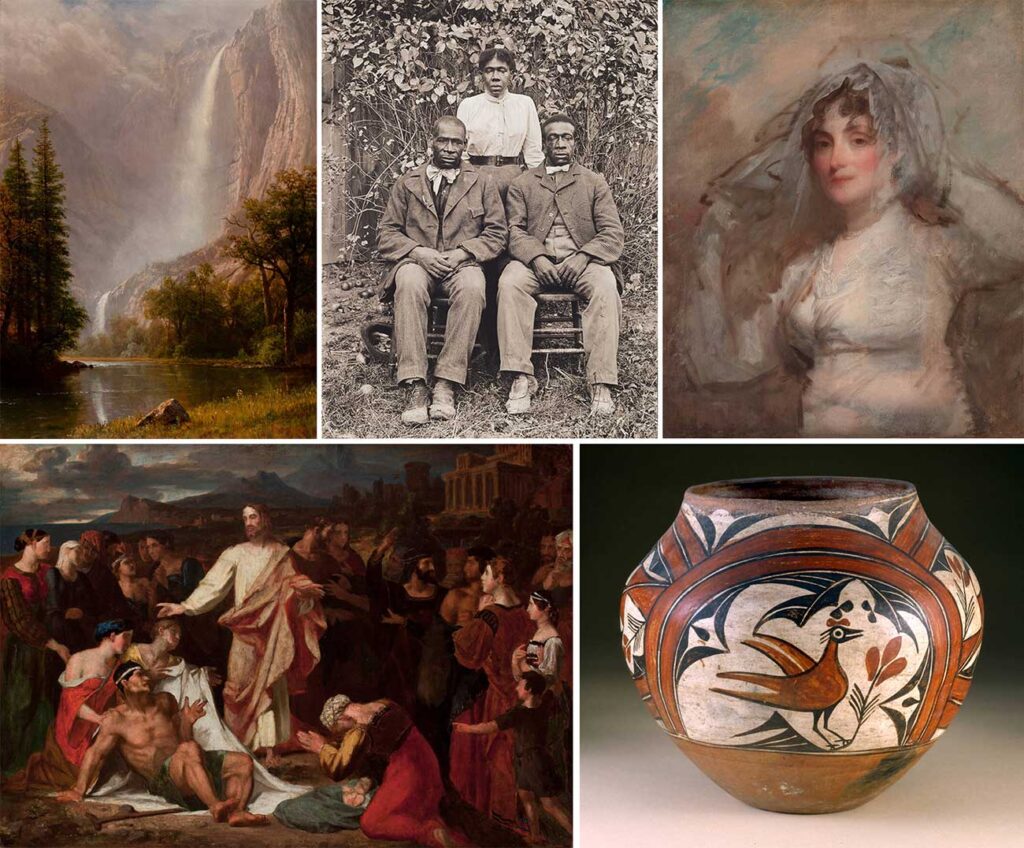
Image (clockwise from top left):
Albert Bierstadt, Yosemite Falls, 1865–1870, oil on canvas, Gift from the Estate of Mrs. William H. Sawyer, Jr., 1954.66
William Bullard, Rose Perkins and her Brothers Edward and Abraham, about 1900, printed 2017
Gilbert Stuart, Sarah Wentworth Apthorp, Mrs. Perez Morton, about 1802, oil on canvas, Gift of the grandchildren of Joseph Tuckerman, 1899.2
Unidentified Artist (Zia Pueblo), Water Jar with Rain Bird Design, about 1900–1910, painted ceramic, Gift of Miss Amelia Elizabeth White, through the courtesy of Mrs. John Sloan, 1942.10
Washington Allston, Christ Healing the Sick, 1813, oil on laminated millboard, Museum Purchase, 1920.91