
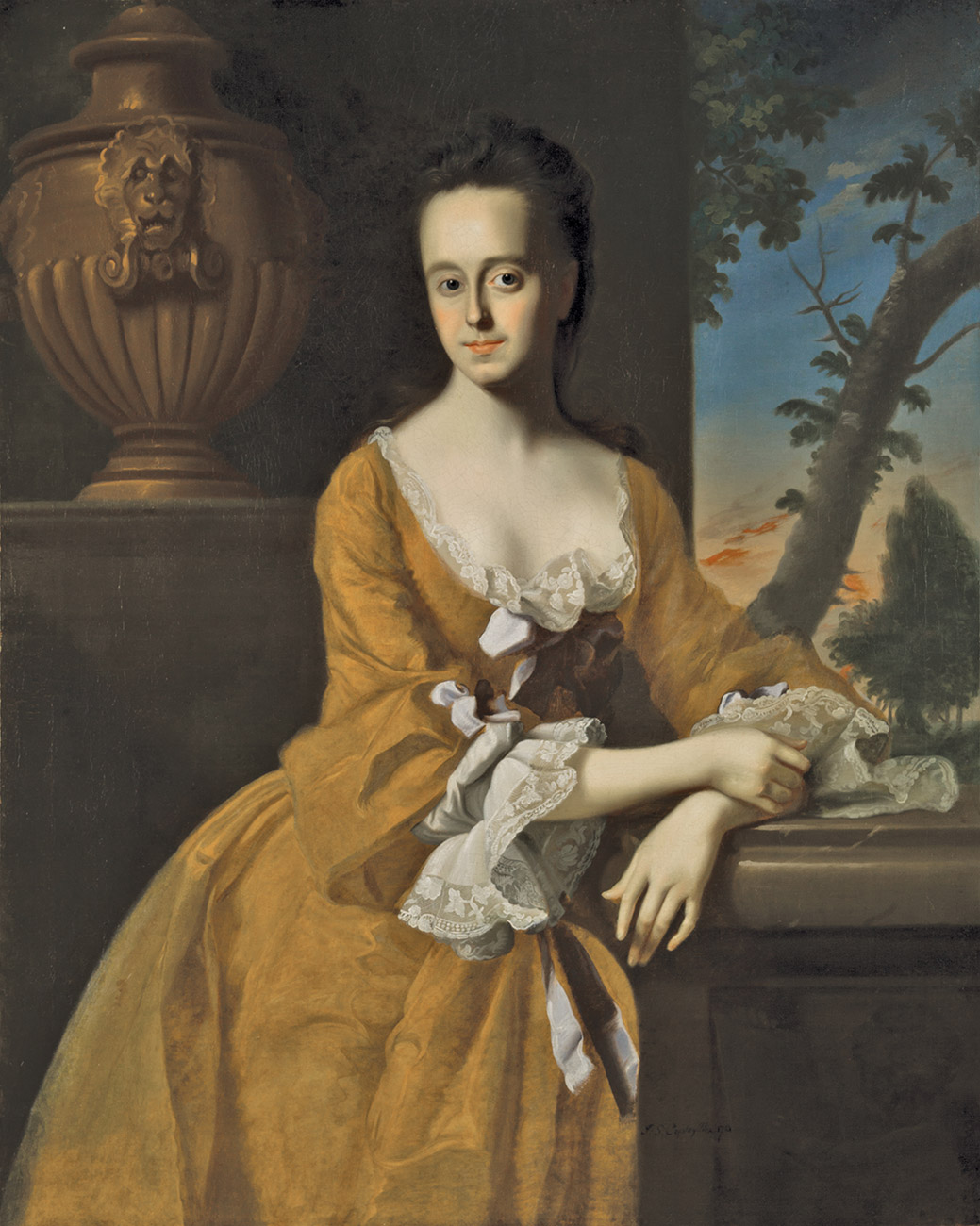
John Singleton Copley’s Portrait of Lucretia Chandler, Mrs. John Murray, (1763), originally hung in the main room of one of the most fashionable homes in Rutland, Massachusetts. The subject of the painting, Lucretia Chandler Murray (then aged 31), leans against a pedestal with her arms casually crossed. The direct look in her blue eyes and faint smile on her lips give a hint of her personality, while Copley’s skill with details and textures can be seen in the rich yellow fabric of her dress, the wide lace cuffs, and the loose brown curls escaping from her pulled-back hair.
Another portrait, nearly identical, can be seen in the collection of the Museum of Fine Arts, Boston—the Portrait of Katherine Greene Amory (Mrs. John Amory) (1763), depicting Lucretia’s cousin. In the Art Institute of Chicago hangs another cousin in the Portrait of Mary Greene Hubbard (Mrs. Daniel Hubbard) (1764).
While there are differences in the portraits—each sleeve ends in a unique lace pattern, the tilts of the chins vary slightly, Lucretia wears her hair differently from the Cousins Greene—the pose and dress are identical in each, down to the folds in the fabric and the crook of the smallest finger.
“This series is interesting, because it’s where the dress and pose are copied so exactly,” says WAM’s former Andrew W. Mellon Conservation Fellow, Hae Min Park, who has been conserving the portrait of Lucretia in preparation for the upcoming exhibition, Beyond Midnight: Paul Revere (on view at WAM from February 15 to June 7, 2020). The sitters likely chose the same look to reflect their close relationship (two of their husbands—John Murray and Daniel Hubbard—also have Copley portraits from 1763-64, also nearly identical to each other).
“These wealthy colonists wanted to look like the English elites,” says Park. “They commissioned portraits not of what they looked like, but what they could be. “They sought images of themselves in the latest fashions and surrounded by the symbols of old-world wealth, as seen in portraits and mezzotints from Europe—despite not actually owning such clothing and items themselves.
Enter John Singleton Copley, an accomplished artist and owner of a sizeable library of mezzotints (steel or copper plate prints), depicting portraits of English nobility. By age 15, Copley had learned to copy these prints on oil-painted canvas and to create a new portrait by inserting the sitter’s likeness, changing props and pose to suit them.
Be the first the hear about new articles and videos in the Member Monthly email newsletter. Members receive year-round free admission, tickets to events, and more.
Copley likely kept his most popular prints arranged in a book, from which clients could select their desired pose and background; seeing the original print would have helped patrons to visualize the final product. Lucretia and her cousins all chose to base their portraits on a print of Mary Howard (née Finch), Viscountess Andover (1746) by English artist Thomas Hudson (1701–1779). The dress, pedestal, and pose are an exact match. Lucretia, however, chose to replace the Mary Howard background with a unique one, combining elements from three other mezzotints in Copley’s collection.
All three women also altered the original dress to match current fashions. “The style of dresses changed very rapidly between 1746 and 1763,” explains Park. “In 1763, the color of the yellow dress they wear was very popular—but only for a short while.”
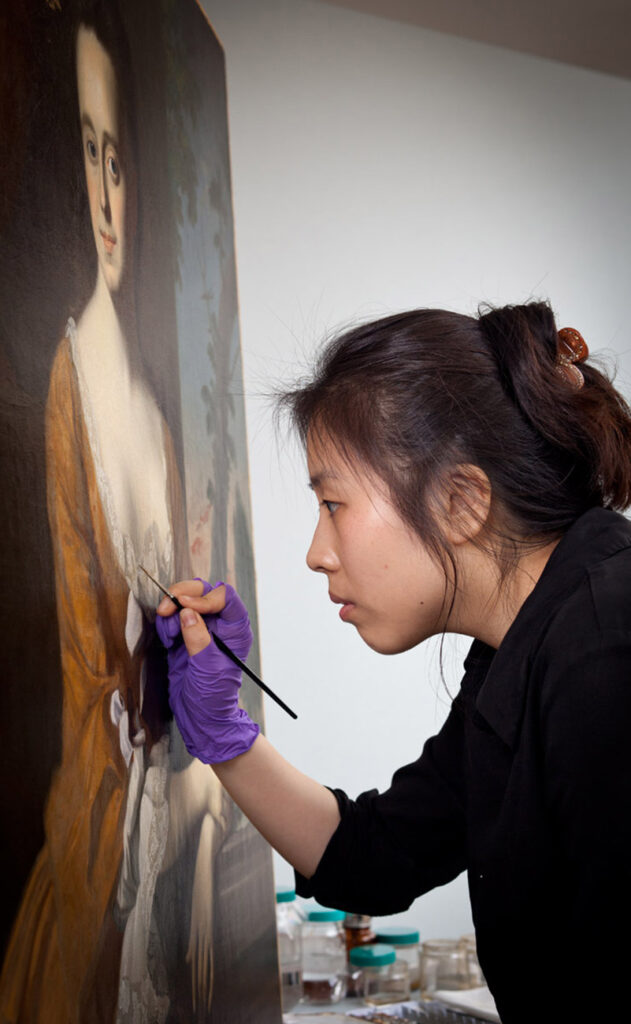
Once the pose was selected, Copley copied and enlarged it using the grid method; he placed or drew one grid over the selected mezzotint and rendered another on his canvas in pencil. Then, slowly and meticulously, he redrew each square of the grid on to his canvas, creating a highly accurate copy. When the oil paints were applied, the original pencil lines were no longer visible, and the illusion was complete.
Copley was not alone in his methods; researchers today believe many other artists used the same or similar techniques. However, Copley was by far the most successful—and most in-demand—portraitist in the colonies. During the first 20 years of his career (1753–1774), he created over 300 individual portraits, not only oil paintings, but also pastels and miniatures, the first colonial-born artist to employ either technique.
What made Copley’s artwork so popular? It was likely his ability to find the right balance between depicting his clients as they truly looked, and portraying them as they wished to be seen.
“John Singleton Copley’s triumph stemmed not only from his craftsmanship, but also his ability to indulge the social, cultural, and political leanings of his affluent colonial patrons,” explains Park. “By rearranging and incorporating elements taken directly from the engravings, Copley’s embellished representations of his clients granted hem—albeit fictitiously—their desired wealth and standing.”
Taken and adapted from the 2019 fall/winter edition of the Worcester Art Museum’s access Member magazine.
Stay connected! Sign up for the Worcester Art Museum’s email newsletter.