
Five hundred years ago a six-foot-tall man galloped headlong into battle, confident and fierce, his Maximilian field armor glinting in the morning sun. “The knight is the tank of the battlefield, punching through the enemy line,” says Jeffrey Forgeng, curator of arms and armor and medieval art. “He’s armored, powerful, forceful—the highly mobile element on the battlefield. He looks like a tank, so big, so imposing and yet gorgeous.”
Arms and armor are very popular with visitors, and the Worcester Art Museum’s magnificent Maximilian field armor is one of the most prominent pieces in its 2,000-piece collection—which in North America is second only to the Metropolitan Museum of Art. And thanks to Bill MacMillan, arms and armor conservator, the knight never looked shinier or more viscerally impressive.
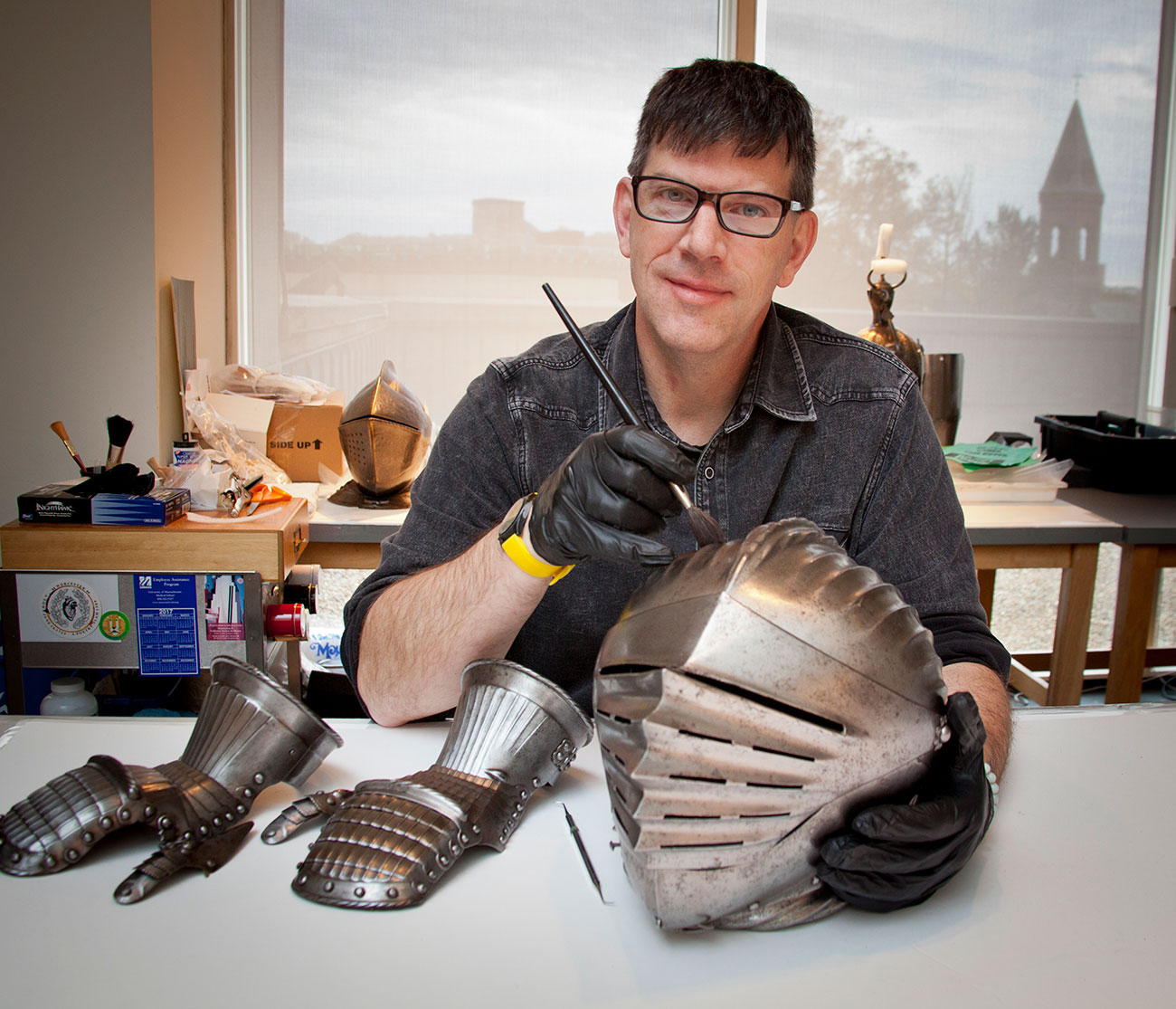
MacMillan completely dismantled the 500-year-old Maximilian armor and spent over four months cleaning, restoring, studying, and documenting its every nook and cranny. This rare and impressive piece is currently on display in the Museum’s Arms and Armor Galleries.
The Maximilian armor was made around 1525 and is one of the few complete and intact armors from that time. “It is a star piece in the Higgins Collection,” says Forgeng, “a tour de force at a time when the craft was in its final flourishing.” It was made to emphasize the power and masculinity of the wearer.
Armor design closely emulated the male haute couture of the day. “Men were totally the peacocks back then, and battlefield dress was as impressive as anything you would wear in court. The armor was voluminous, styled in that period of Henry VIII, massive and imposing,” he explains.
MacMillan, who took a near-microscopic look during the conservation process, has a soft spot for the maker of such finely crafted armor. “I look at the hammer marks, the sculpted interior edges, and I see how they approached it, how they made it, how good they were.” The full suit of armor weighs only 64 pounds, 14 ounces, compared with the 80 to 130 pounds the contemporary foot soldier must carry.
Be the first the hear about new articles and videos in the Member Monthly email newsletter. Members receive year-round free admission, tickets to events, and more.
Despite the casual viewer’s first impression, a knight’s armor was flexible. A knight had to be mobile. He had to get up quickly if knocked off his horse. “The armor is very well articulated,” says MacMillan. “It has much greater range than people think. I’m not saying you could go out and do a full night of dancing, but you could if pressed. You would just get really hot.” In fact, says MacMillan, “the only thing you can’t do in armor is scratch between your shoulder blades.”
This kind of precision crafting requires comparable precision conservation.
“The armor is made out of steel, and steel rusts,” says MacMillan. “It gets dirty, the leathers get old, dirt accumulates, and people touch it even though they’re not supposed to. Dust build-up causes moisture to accumulate. Occasionally, he needs a really good cleaning.”
Before this conservation, the Maximilian armor hadn’t had a full conservation treatment in over 30 years. To begin the work, MacMillan disassembled the armor. It has 15 main pieces, but each section is made up of many smaller parts. “I take time to look over the pieces, the leathers, the rivets, the old repairs that need attention. I wash the pieces with mineral spirits to remove the dust and dirt. I remove the corrosion as best as I can, using polishing papers and light abrasives. I photograph all the pieces inside and out, before and after. We can see the changes that way, and document what we’ve done.”
Most viewers will only perceive the full and magnificent power of the armor, thanks in part to the hard work of the conservation staff. “The armor’s been well used,” says MacMillan. “But it will survive in good shape for another 50 or 100 years until another group of conservators stabilize things once again. Conservation is a little like holding back the ocean with a broom.”
Taken and adapted from the 2019 winter/spring edition of the Worcester Art Museum’s access Member magazine.
Stay connected! Sign up for the Worcester Art Museum’s email newsletter.