Claude Monet’s serial approach to landscape painting—in particular his signature groupings of the Rouen Cathedrals, Poplars, and the first of the Water Lilies—is well known. Less so are the subjects he explored in London from 1899 to 1901, even though they resulted in over 100 canvases. One of these subjects, London’s Waterloo Bridge, spurred a series of its own.
Monet’s first use of the series as a tool for experimentation was in 1877, when he painted a dozen canvases featuring the Gare Saint-Lazare, Paris’ busiest train station. However, his Grainstacks, begun in 1889 (and often mistranslated as haystacks), are generally regarded as his first foray into using a serial approach. Painting the same subject repeatedly was a way for the artist to use various natural and architectural elements to articulate the way time, light, and atmosphere affect how we perceive the landscape.
Until the Grainstacks, Monet’s practice could best be described as itinerant. He was constantly in motion, traveling throughout France and abroad. He went to London for the first time in 1870 to avoid conscription into the Franco-Prussian war. The wear and tear of a nomadic existence, in combination with financial insecurity, took considerable toll on the body and mind of the headstrong artist. By the time Monet began work on the Grainstacks, he was an aging 50-year-old with a frustrated live-in mistress (later wife), Alice Hoschedé, and hungry children. In light of these factors, Monet’s serial approach to painting was, at least initially, a practical solution. It allowed him to investigate shifts in light and atmosphere while remaining in one place.
When the public responded favorably to the Grainstacks, Monet embraced the serial approach and finally realized the prestige that had previously eluded him. In the fall of 1899, having accumulated both professional admiration and relative wealth, Monet embarked on the first of three extended trips to London. Over the course of these visits, he focused on three London landmarks: The Houses of Parliament, Waterloo Bridge, and Charing Cross Bridge. Unlike his early days of dragging easel and paints down craggy cliffs on the Normandy coast, Monet painted both of the bridge series from the comfort of his live-in studio on the fifth and sixth floors of the fashionable Savoy London Hotel.
What unites all three London series is the fog, partly a product of the city’s notorious pollution. The painter marveled at the way a murky haze could sweep in and swallow the city whole. According to Monet, depicting fog required “rapid notations” in paint: “Objects change in appearance in London fog more and quicker than in any other atmosphere.”1
Be the first the hear about new articles and videos in the Member Monthly email newsletter. Members receive year-round free admission, tickets to events, and more.
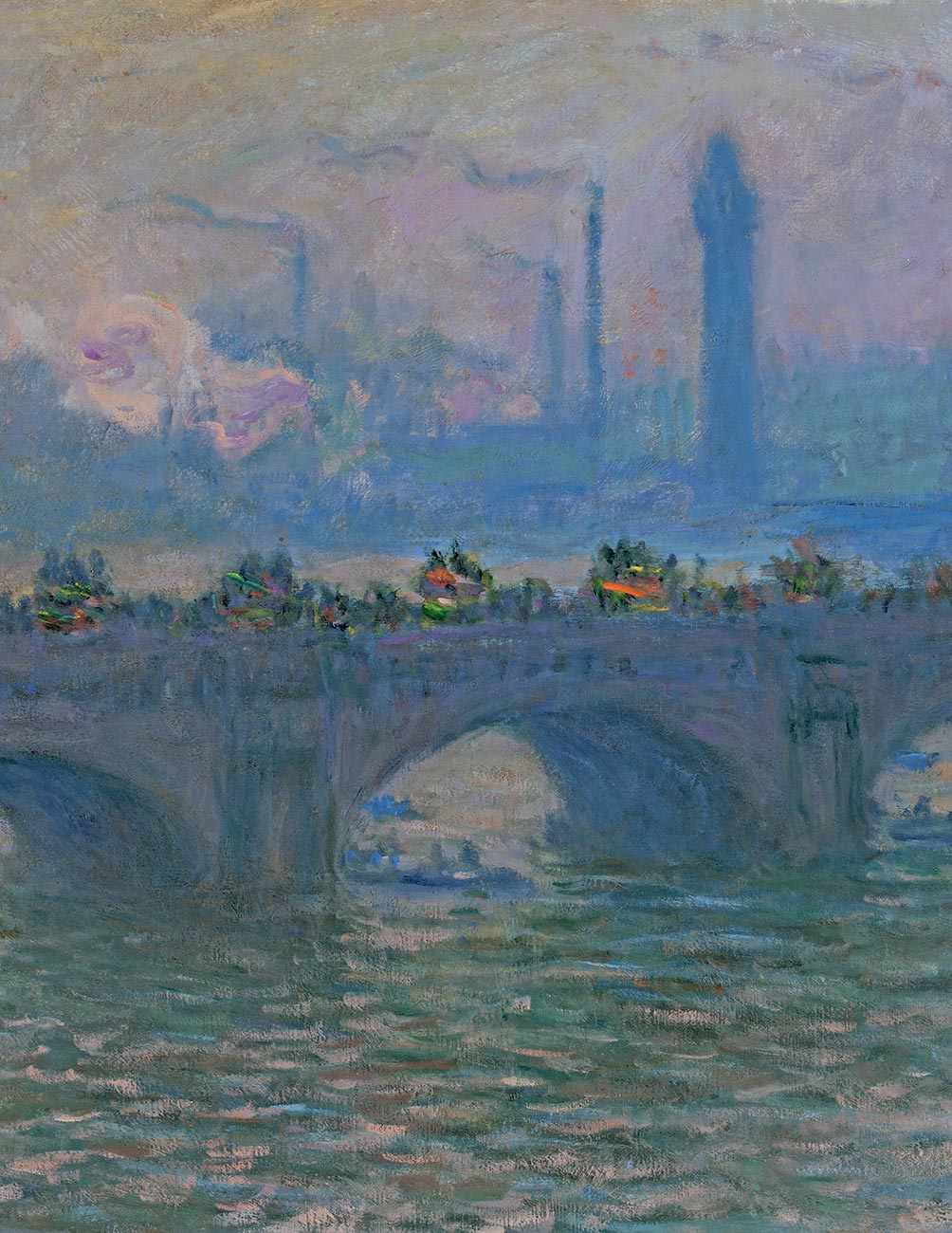
There are 41 known Waterloo Bridge canvases, the largest grouping to result from the 1899, 1900, and 1901 London tours. Waterloo is the most industrial of the three London motifs and in many ways an image of modernity. Opened as a toll bridge in 1817, Waterloo Bridge was nationalized for public use in 1878. Monet’s many canvases highlight the movement of traffic, people, and contemporary shipping vessels. In addition to the subject matter, the element that ties together nearly all of the 40-plus Waterloo paintings is the use of blue. Monet often used cobalt blue to establish structure in his early sketches. By his own reports, Monet employed a surprisingly limited palette, heavily reliant on his masterful ability to blend paint directly on the canvas.2
The Worcester Art Museum’s version of Waterloo Bridge, 1903 (1910.37), was purchased directly from Paul Durand-Ruel in 1910, just two months after Monet sold it to him. Visually Worcester’s painting is most similar to Waterloo Bridge, Gray Weather (1900) at the Art Institute of Chicago. Based on the results of scientific analysis conducted by conservation teams at both institutions, both paintings are thinly painted and dominated by cobalt blue, green, and violet.
Monet’s London series explored the city not in isolation, but as a place where the subtleties, nuances, and variations of light, color, and atmosphere can be appreciated and understood.
1 From a 1901 interview with American journalist Emma Bullet.
2 The Worcester Art Museum’s Version of the Waterloo Bridge, 1903 (1910.37), was purchased directly from Paul Durand-Ruel in 1910, just two months after Monet sold it to him. Visually Worcester’s painting is most similar to Waterloo Bridge, Gray Weather (1900) at the Art Institute of Chicago. Based on the results of scientific analysis conducted by conservation teams at both institutions, both paintings are thinly painted and dominated by cobalt blue, green, and violet.
This article was featured in the winter/spring 2019 edition of the Worcester Art Museum’s access Member magazine.
Monet’s Waterloo Bridge: Vision and Process, January 25–April 28, 2019
Stay connected! Sign up for the Worcester Art Museum’s email newsletter.